Researchers discover hidden ‘recycling system’ that helps keep photoreceptors healthy
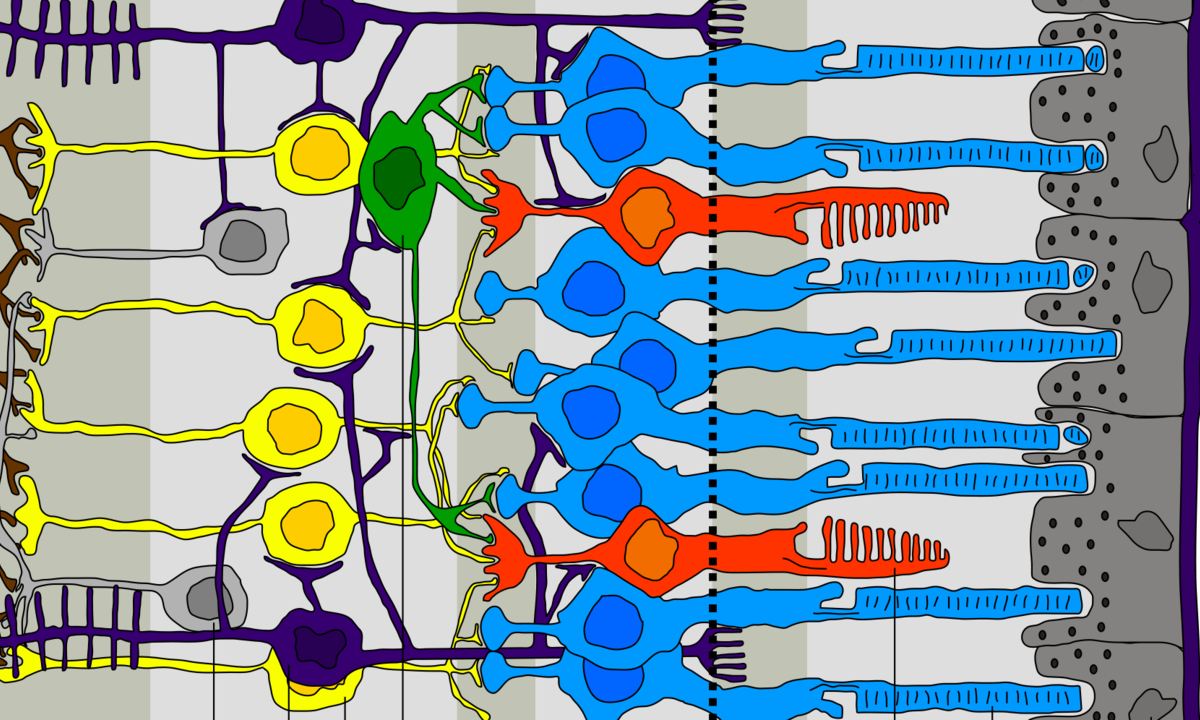
For decades, scientists believed that photoreceptors relied primarily on the retinal pigment epithelium (RPE) to remove waste. While the RPE is still responsible for clearing away the worn-out tips of photoreceptors each day, new findings from the University of Oklahoma reveal that photoreceptors also perform much of their own internal housekeeping.
The study is published in Cell Death & Disease.
“Our study provides the first direct evidence that photoreceptors possess their own internal recycling system that is essential for their survival. Instead of relying solely on the RPE, photoreceptors recycle and break down their own damaged proteins and cellular components using lysosomes, the cell’s recycling centers,” said lead author Raju V.S. Rajala, Ph.D., an OU College of Medicine professor in the Dean McGee Department of Ophthalmology and Department of Biochemistry and Physiology.
Because photoreceptors are constantly active and require tremendous amounts of energy, they continuously produce damaged proteins and worn-out cellular components that must be removed. Without an efficient recycling system, this cellular waste builds up, causing the cells to malfunction and eventually die.
At the center of this recycling system is PIKfyve, an enzyme (lipid kinase) that produces a specific signaling lipid, which is essential for the proper function of lysosomes. The researchers found that PIKfyve is especially abundant in rod photoreceptors, the light-sensing cells responsible for vision in low light.
PIKfyve is critical for the health of the RPE
To understand how this process works, researchers removed PIKfyve in mice. Without it, the photoreceptors’ recycling system broke down. Damaged proteins accumulated inside the cells and the photoreceptors gradually degenerated, leading to progressive vision loss. This degeneration was marked by visible cellular vacuolation, elevated levels of lysosomal marker proteins, thinning of the outer nuclear layer — the retinal layer containing photoreceptor cell bodies — and a measurable decline in both rod and cone visual function.
The team also found that PIKfyve is critical for the health of the RPE itself. When the enzyme was absent, fats and cellular waste accumulated in these support cells, producing changes similar to those seen in age-related macular degeneration. Specifically, the loss of PIKfyve disrupted two key cleanup processes in the RPE — phagocytosis, by which the RPE engulfs shed photoreceptor material, and autophagy, the cell's internal recycling process. This led to a buildup of rhodopsin (the light-sensing protein normally confined to photoreceptors), lysosomal proteins, and lipid droplets, along with broader disturbances in the cells' metabolism.
“These discoveries change our understanding of retinal biology,” Rajala said. “Photoreceptors are not passive cells that depend entirely on the RPE for waste disposal. Instead, they possess an active quality-control system that continuously removes damaged proteins and maintains cellular health.”
Important implications for many inherited retinal diseases
These results demonstrate that PIKfyve is essential for maintaining photoreceptor and RPE integrity by supporting lysosomal function, protein turnover, and metabolic stability. The findings may have important implications for many inherited retinal diseases, which are often linked to problems with cells’ ability to clear away damaged proteins. In mice carrying the P23H rhodopsin mutation — a widely used model of inherited retinitis pigmentosa — reducing PIKfyve further accelerated retinal degeneration, reinforcing its role in disease already driven by misfolded protein. By identifying PIKfyve as a central regulator of this process, the researchers have uncovered a promising new target for therapies designed to preserve vision before irreversible damage occurs, and suggest that boosting, rather than blocking, PIKfyve activity could offer a path toward preserving vision.
The research also raises important safety questions for drug development. A drug called Apilimod, which blocks PIKfyve, is currently being studied as a potential treatment for autoimmune diseases, certain cancers, neurodegenerative diseases such as amyotrophic lateral sclerosis (ALS), and viral infections such as COVID-19 and Ebola. While the drug may prove beneficial for those conditions, the new findings suggest that inhibiting PIKfyve could interfere with the retina’s natural recycling system, highlighting the need to carefully evaluate potential effects on vision during future clinical testing, Rajala said.
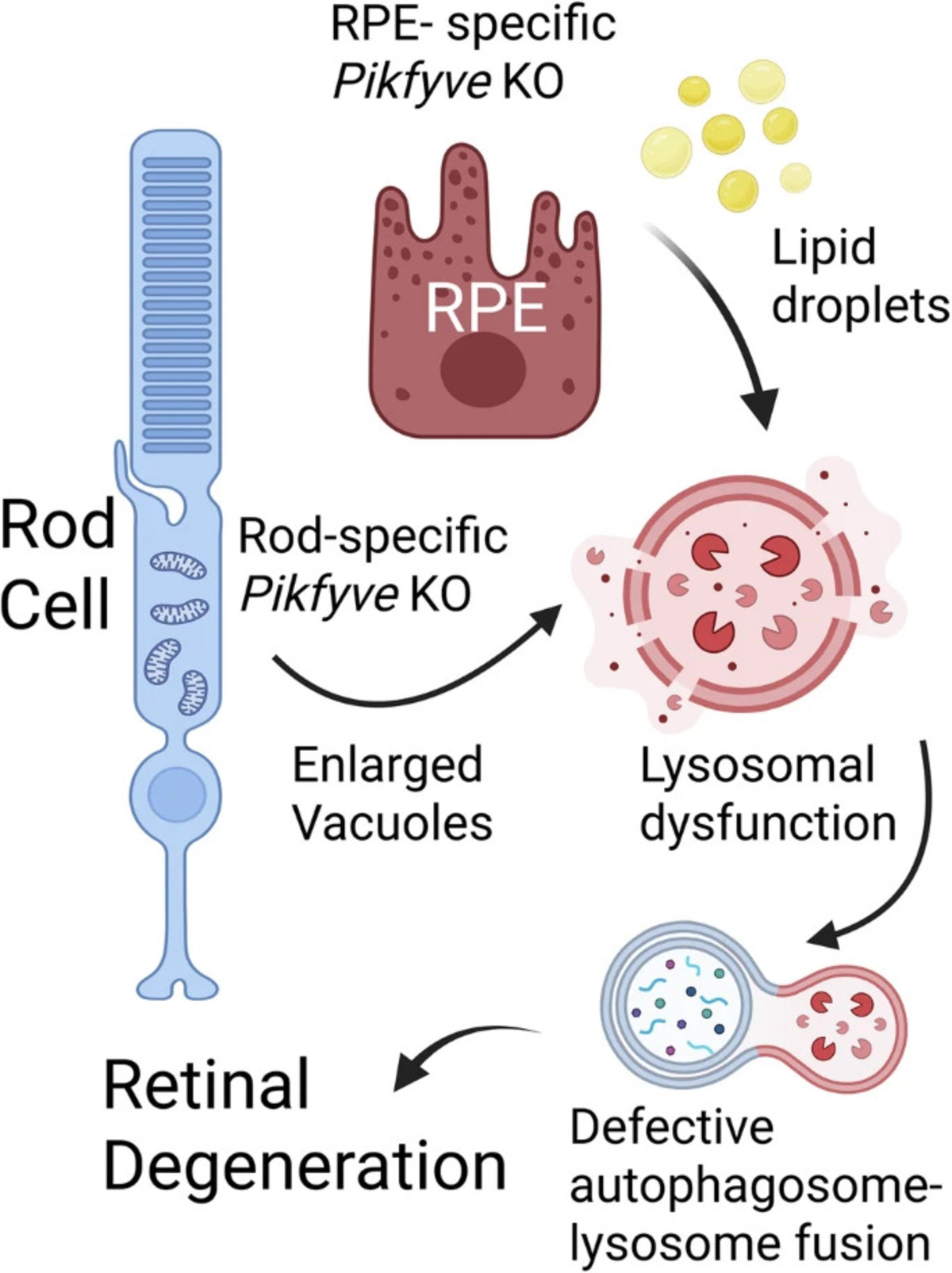
Graphical abstract. Cell Death & Disease
Rajala, A., Trevino, L.J., Saravanan, T. et al. PIKfyve preserves endolysosomal function in photoreceptors and RPE cells to maintain retinal integrity. Cell Death Dis (2026). https://doi.org/10.1038/s41419-026-08855-2