EssilorLuxottica showcases an integrated scientific ecosystem across the eye care continuum at ARVO 2026
EssilorLuxottica marked a major milestone at ARVO 2026, presenting for the first time a fully integrated vision care and med-tech ecosystem through a coordinated scientific program spanning the entire eye care continuum. Combining capabilities in vision care and medical technologies – including Heidelberg Engineering, RetinAI and Espansione – the Group demonstrated how it integrates technologies, data and clinical expertise within a unified, science-led ecosystem.
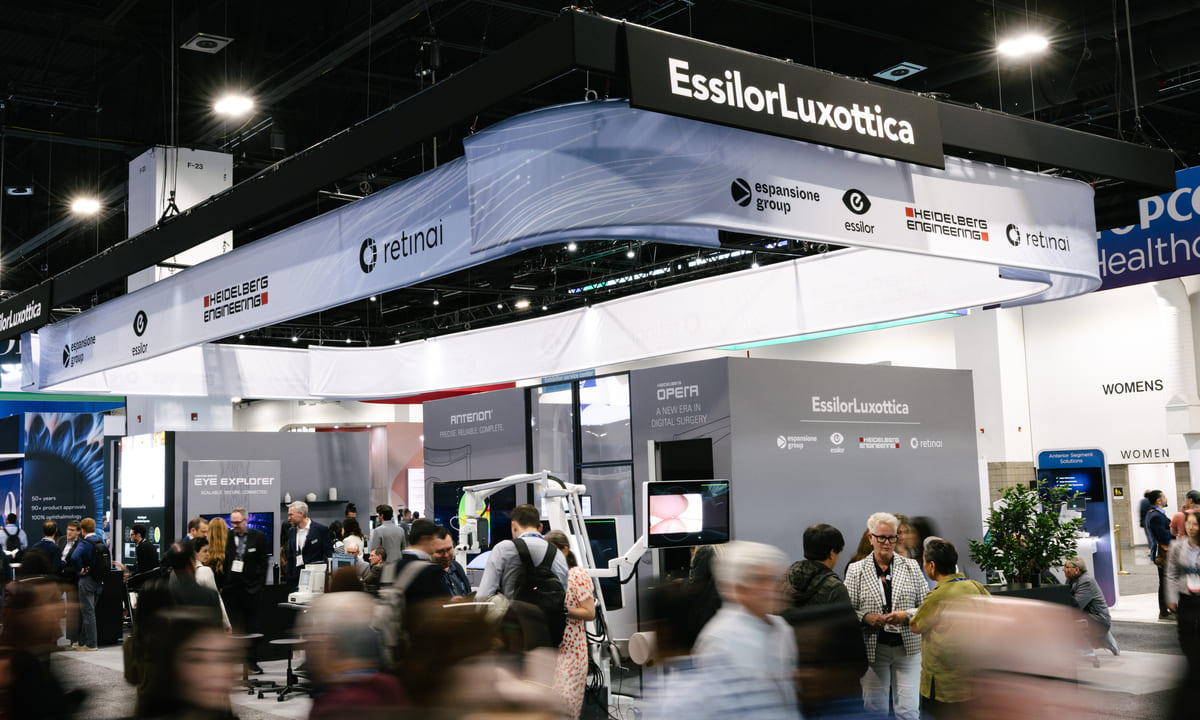
This integrated model brings together myopia management and vision science, advanced diagnostics, AI-driven analytics and technology-enabled therapeutic solutions to support more holistic, data-driven patient care. At ARVO, EssilorLuxottica presented over 20 peer-reviewed scientific abstracts, underscoring the depth of its research and its contribution to the global scientific community.
“The integration of advanced imaging, AI-driven analytics and therapeutic technologies is transforming how we understand and manage eye diseases,” said Norbert Gorny, Chief Scientific Officer at EssilorLuxottica. “At ARVO 2026, we demonstrated how these capabilities enable a more connected, data-driven approach to eye care, from earlier detection to more informed patient management.”
Strengthening the evidence base in myopia management and vision care
New clinical evidence reinforced EssilorLuxottica’s leadership in myopia management, with eight abstracts focused on clinical outcomes, long-term efficacy and mechanisms of progression control. A seven-year follow-up study of Essilor Stellest lenses* in China demonstrated sustained efficacy, with 2.31 D less myopia progression and 0.92 mm less axial elongation1 in adolescents up to 19 years old. These findings are supported by additional data, including a multicenter clinical trial in the United States2-5 and recent FDA market authorization.6 An analysis of 26 published studies confirmed consistent efficacy across study designs and populations, with reduced axial elongation compared to single vision lenses.7
Further research explored key areas of vision science and clinical practice, including chromatic mechanisms in emmetropization,8 simulation models for predicting myopia control efficacy,9 ultra-fast light-adaptive lens performance and contrast sensitivity recovery,10,11 binocular refraction methodology using Vision-R 80012 and functional near addition requirements in young presbyopes.13
From advanced imaging and AI analytics to therapy: a collaborative path EssilorLuxottica also showcased innovations in medical technologies, highlighting their role in enabling earlier insights, improving clinical decision-making and advancing more personalized care.
“Heidelberg Engineering’s pioneering work in multimodal imaging with ultra-high resolution OCT and fully digital surgical microscopy is opening a new era in imaging and surgery. Together with RetinAI’s AI-powered insights and Espansione’s treatment options, we are transforming science into meaningful impact for patients, clinicians, researchers and the future of eye care”, said Ettore Mosca, Head of Medical Technologies at EssilorLuxottica.
Over 200 posters and papers presented at ARVO featured Heidelberg Engineering technologies, underscoring their contribution to ophthalmic research and clinical practice. Among the showcased highlights were the Multimodal Imaging Platform with Ultra High Resolution OCT14 designed to deliver unprecedented image quality. Furthermore, the Heidelberg OPERA digital surgical microscope with intraoperative OCT**, was presented. The platform provides real-time visualization during surgery and was designed to enhance surgical precision.
Together, Heidelberg Engineering and RetinAI also showcased the first truly automated end-to-end DICOM workflow from advanced image acquisition on the Heidelberg Engineering Multimodal Imaging Platform with Ultra High Resolution OCT to automated upload to the cloud and seamless AI-powered analysis in RetinAI Discovery, all while offering native DICOM format from A-Z, standardized, fully secured and seamless.
In parallel, RetinAI has unveiled major updates to its Discovery platform, centering on AI-driven tools, highlighting the launch of the CE-marked AI models RetinAI OCT Atlas and LuxIA, the company’s first AI screening model for diabetic retinopathy. These additions, alongside new predictive modeling for geographic atrophy, aim to automate clinical workflows and enhance candidate identification and evidence generation in clinical studies.
Additionally, Espansione highlighted a broad portfolio of innovative solutions built on its light-based therapeutic platform, eye-light, as well as the evidence-based applications and benefits of photobiomodulation across retinal and ocular surface care.15
An integrated scientific ecosystem across the eye care continuum
EssilorLuxottica’s unified presence at ARVO reflects a coordinated scientific approach integrating vision science and medical technologies. Expert-led talks powered by Leonardo, the Group’s learning ecosystem, fostered scientific exchange and evidence-based discussions on key topics shaping the future of eye care. Two Exhibitor Education Forum sessions further brought together internal and external experts to discuss multi-year clinical outcomes in myopia management and the collaborative pathway from advanced imaging and AI-driven analytics to therapeutic approaches.
“ARVO 2026 marks an important step in advancing our research in vision science and ophthalmology,” said Olga Prenat, Head of Medical & Professional Affairs at EssilorLuxottica. “By presenting new clinical and scientific findings across vision care and medical technologies, we strengthen the evidence base for clinical practice – supporting better insights, decisions and outcomes for patients.”
Notes:
* Regulatory status and product availability may vary by country. US FDA authorization and indications for use are based solely on clinical trial data from the US.
** In development. Not for clinical use. Can only be made available once it has regulatory clearance
1. Li X, et al. Myopia control efficacy of spectacle lenses with highly aspherical lenslets: results of a 7-year follow-up study. ARVO 2026 Annual Meeting; 2026 May 3-7; Denver, CO. Poster 0968
2. Shen J, et al. Two‑year safety and effectiveness of Stellest lenses for slowing myopia progression in a US pediatric population. ARVO 2026 Annual Meeting; 2026 May 3‑7; Denver, CO. Poster 1229-0999
3. Wong YL, et al. Comparison of 24-month astigmatism changes between Stellest and single vision lenses in US children. ARVO 2026 Annual Meeting; 2026 May 3-7; Denver, CO. Poster 1229-0967
4. Lim EW, et al. Impact of age and baseline myopia on the effectiveness of Stellest lenses in a US paediatric population. ARVO 2026 Annual Meeting; 2026 May 3-7; Denver, CO. Poster 1196-0966
5. Gelb C, et al. Safety and visual acuity outcomes of Stellest lenses: 2-year results from a US pivotal trial. ARVO 2026 Annual Meeting; 2026 May 3-7; Denver, CO. Poster 1201-0971
6. US FDA. FDA authorizes marketing of first eyeglass lenses to slow progression of pediatric myopia. Sep 2025. https://www.fda.gov/news-events/press-announcements/fda-authorizes-marketing- first-eyeglass-lenses-slow-progression-pediatric-myopia
7. Bullimore M, et al. Myopia Control with Spectacle Lenses with Highly Aspherical Lenslets (HAL). ARVO 2026 Annual Meeting; 2026 May 3-7; Denver, CO. Poster 0978
8. Ditullio R, et al. Coloring our perspective: the importance of chromatic features in emmetropization. ARVO 2026 Annual Meeting; 2026 May 3‑7; Denver, CO. Poster 0103
9. Hamlaoui S, et al. Predicting the efficacy of myopia control lenses by simulating their optical effect on the retina. ARVO 2026 Annual Meeting; 2026 May 3-7; Denver, CO. Poster 4646
10. Barrau C, et al. Ultra-fast light-adaptive lenses and visual recovery. ARVO 2026 Annual Meeting; 2026 May 3-7; Denver, CO. Poster 0899
11. Duarte-Toledo R, et al. Dynamic contrast sensitivity recovery in children with photochromic Highly Aspherical Lenslet lenses under transient light conditions. ARVO 2026 Annual Meeting; 2026 May 3-7; Denver, CO. Poster 0902
12. Hernandez Castaneda M, et al. Reproducibility and Benefit of a New Binocular Refraction. ARVO 2026 Annual Meeting; 2026 May 3-7; Denver, CO. Poster 0492
13. Josse G, et al. Addition based on proximity in young presbyopes. ARVO 2026 Annual Meeting; 2026 May 3-7; Denver, CO. Presentation OD317
14. Dolz-Marco R, et al. Evaluation of Enhanced Confocal Scanning Laser Ophthalmoscopy Imaging using a Heidelberg Engineering prototype. ARVO 2026 Annual Meeting; 2026 May 3-7; Denver, CO. Poster 4022 - 0236
15. Pignataro M, et al. Photobiomodulation-induced choriocapillaris perfusion enhancement and outer retinal remodeling in intermediate AMD: 12-month follow-up results. ARVO 2026 Annual Meeting; 2026 May 3-7; Denver, CO. Abstract 3656. Poster 0749