400 years of vision: Greenland shark’s retina defies aging
A study in Nature Communications shows that the Greenland shark (Somniosus microcephalus), the longest-living vertebrate, maintains a fully functional retina even at extreme ages of up to 400 years. Despite living in near-total darkness and often carrying parasitic corneal infestations, the shark’s eye remains structurally and molecularly intact, offering surprising insights into retinal longevity and age-related eye preservation.
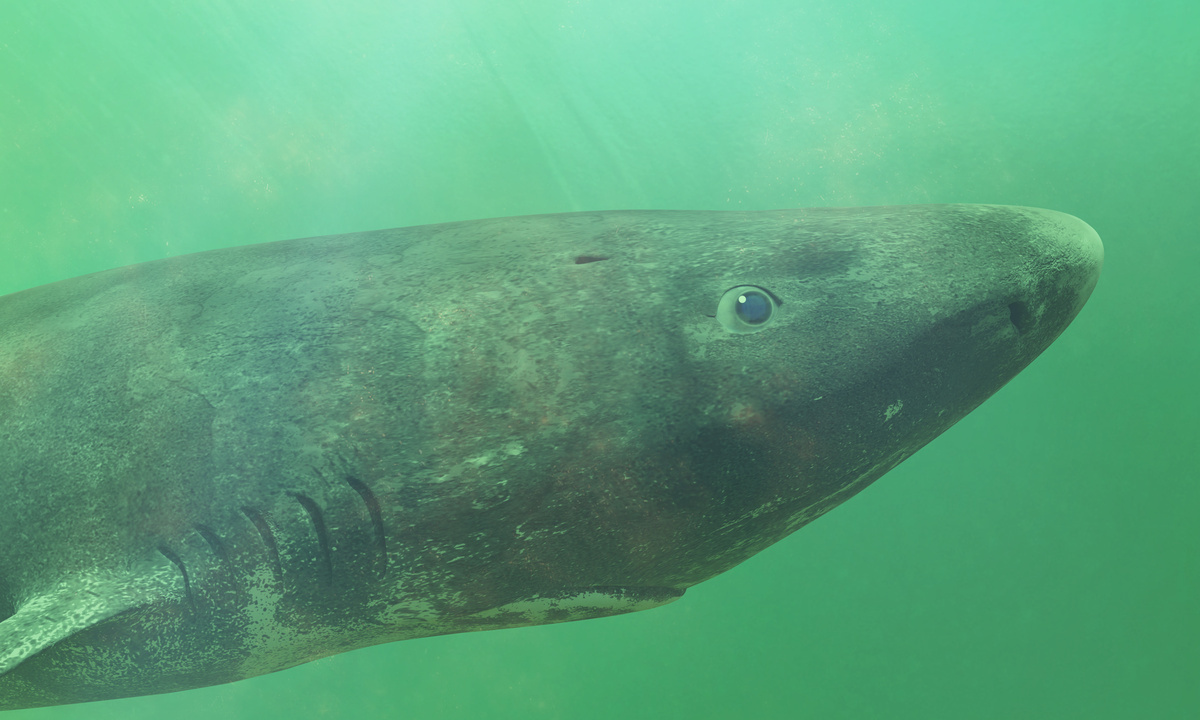
Researchers combined whole-genome and retinal RNA sequencing, in-situ hybridization, histology, opsin biochemistry and functional assays to examine Greenland shark eyes. Their main results: an intact phototransduction gene set for scotopic (rod) vision with robust expression in the retina; loss or pseudogenization of many cone (bright-light) pathway genes; histological specializations typical of deep-sea species (elongated, densely packed rods); and no obvious signs of retinal degeneration in century-old specimens.
Key details
-
Rod-dominated retina: Molecular and histological data indicate that the shark’s visual system is optimized for dim light — elongated, densely packed rods and a rhodopsin spectral sensitivity shifted toward shorter (blue) wavelengths, consistent with deep-water photon availability.
-
Cone pathway loss: Genomic evidence shows pseudogenization or loss of many cone phototransduction genes, supporting functional reliance on scotopic vision rather than photopic vision.
-
Preserved retinal circuitry: In-situ hybridisation detected key retinal cell types (rods, Müller glia, bipolar, amacrine and ganglion cells), and chromatin/RNA data show active transcription of rod pathway genes — together suggesting a functioning retinal circuit rather than a vestigial organ.
-
No obvious age-related degeneration: Despite specimen ages of decades to centuries, examined retinas did not show the clear degenerative changes one might expect, even in eyes that were externally clouded or parasitised.
-
DNA-repair activity: The retina shows robust expression of DNA-repair–associated genes, which the authors propose may contribute to long-term maintenance of retinal cell integrity across the species’ extreme lifespan. This is the main translational angle of interest for age-related ocular disease research.
The study provides a compelling comparative model for sustained retinal health in an environment that combines low temperature, high pressure, parasitic corneal burden and extreme longevity. For clinicians and researchers, the most relevant points are:
Upregulated DNA-repair pathways and molecular maintenance programs in the retina may reveal targets or strategies to slow or prevent age-related retinal degeneration in humans (for example, pathways relevant to photoreceptor survival and genomic maintenance).
Loss of cone function alongside preserved rod function underscores how selective pressures (light environment) shape photoreceptor utility and maintenance; this may inform how photoreceptor subtypes differentially respond to stress and ageing.
Methods at a glance
The multidisciplinary line-up included genomics and retinal RNA-seq, RNAscope in-situ hybridisation to localize cell-type transcripts, histology and ultramicrotomy for retinal structure, in-vitro opsin regeneration and spectrophotometry for pigment sensitivity, and mass spectrometry and chromatin stains to assess molecular and cellular integrity. Specimens were collected from Greenlandic waters between 2020 and 2024.
Contrary to long-standing assumptions that Greenland sharks are functionally blind, comprehensive molecular and anatomical data show a preserved, rod-centred visual system and surprising retinal resilience. The finding that retinal DNA-repair mechanisms are actively expressed in these long-lived animals opens an evocative — though early — pathway for research into how retinal integrity may be maintained over long time scales and what that could mean for preventing age-related vision loss in humans.
Fogg, L.G., Tom, E., Policarpo, M. et al. The visual system of the longest-living vertebrate, the Greenland shark. Nat Commun 17, 39 (2026). https://doi.org/10.1038/s41467-025-67429-6