Korean researchers develop world’s first wireless OLED contact lens for retinal diagnostics
Electroretinography (ERG) is used to determine whether the retina is functioning normally. It is widely employed for diagnosing hereditary retinal diseases or assessing retinal function decline. A team of researchers at the Korea Advanced Institute of Science and Technology (KAIST) has now developed a next-generation wireless ophthalmic diagnostic technology that replaces the existing stationary, darkroom-based retinal testing method by incorporating an “ultrathin OLED” into a contact lens.
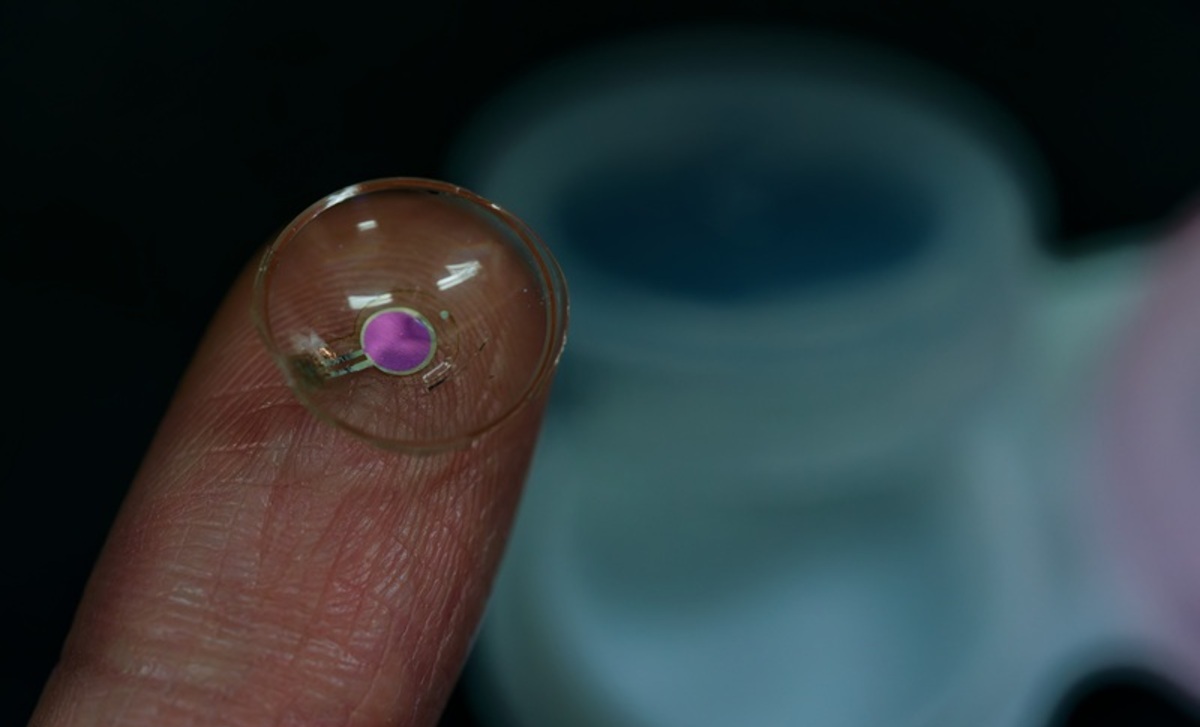
KAIST announced that a research team has developed the world’s first wireless contact lens-based wearable retinal diagnostic platform using organic light-emitting diodes (OLEDs). This technology enables ERG simply by wearing the lens, eliminating the need for large specialized light sources and dramatically simplifying the conventional, complex ophthalmic diagnostic environment. This breakthrough is expected to have applications in diverse fields such as myopia treatment, ocular biosignal analysis, augmented-reality (AR) visual information delivery, and light-based neurostimulation.
Traditionally, ERG requires the use of a stationary Ganzfeld device in a dark room, where patients must keep their eyes open and remain still during the test. This setup imposes spatial constraints and can lead to patient fatigue and compliances challenges.
6–8 times thinner than a human hair
To overcome these limitations, the joint research team integrated an ultrathin flexible OLED —approximately 12.5 μm thick, or 6–8 times thinner than a human hair— into a contact lens electrode for ERG. They also equipped it with a wireless power receiving antenna and a control chip, completing a system capable of independent operation.
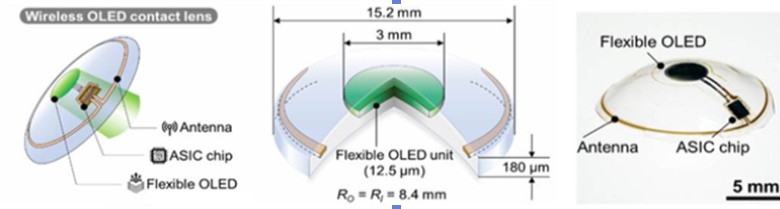
Schematic and photograph of the wireless OLED contact lens. Image KAIST
For power transmission, the team adopted a wireless power transfer method using a 433 MHz resonant frequency suitable for stable wireless communication. This was also demonstrated in the form of a wireless controller embedded in a sleep mask, which can be linked to a smartphone —further enhancing practical usability.
While most smart contact lens–type light sources developed for ocular illumination have used inorganic LEDs, these rigid devices emit light almost from a single point, which can lead to excessive heat accumulation and thus usable light intensity. In contrast, OLEDs are areal light sources and were shown to induce retinal responses even under low luminance conditions. In this study, under a relatively low luminance* of 126 nits, the OLED contact lens successfully induced stable ERG signals, producing diagnostic results equivalent to those obtained with existing commercial light sources.
*Luminance: A value indicating how brightly a surface or screen emits light; for reference, the luminance of a smartphone screen is about 300–600 nits (can exceed 1000 nits at maximum).
Surface temperature of an eye wearing the OLED contact lens remained below 27°C
Animal tests confirmed that the surface temperature of a rabbit’s eye wearing the OLED contact lens remained below 27°C, avoiding corneal heat damage, and that the light-emitting performance was maintained even in humid environments—demonstrating its effectiveness and safety as an ERG diagnostic tool in real clinical settings.
Professor Seunghyup Yoo stated that “integrating the flexibility and diffusive light characteristics of ultrathin OLEDs into a contact lens is a world-first attempt,” and that “this research can help expand smart contact lens technology into on-eye optical diagnostic and phototherapeutic platforms, contributing to the advancement of digital healthcare technology.”
The study was published online in the internationally renowned journal ACS Nano: Wireless Organic Light-Emitting Diode Contact Lenses for On-Eye Wearable Light Sources and Their Application to Personalized Health Monitoring. DOI: https://doi.org/10.1021/acsnano.4c18563
Source: Korea Advanced Institute of Science and Technology (KAIST)